VU Professor Herwig Bachmann has a strong track record of investigating how micro-organisms adapt and can be optimized for industrial use, a topic central to both food and pharmaceutical production. In this interview, Bachmann highlights his interdisciplinary, transdisciplinary and inspiring spin-off activities.
Integrating Molecular Approaches to Refine Fermentation: How In-House Expertise at VU Advances Plant-Based Innovation
Herwig Bachmann’s projects at VU blend multiple layers of molecular biology in pursuit of both fundamental insights and applications in fermentation science. His work has become increasingly multidisciplinary: “For me, the combination is really enjoyable here at VU right now. We have people working on metabolomics, proteomics, transcriptomics, genomics and we are collaborating with computational biologists/chemists and bioinformatics. We can investigate many aspects of a problem with the expertise available at VU”.
Together with AIMMS scientists they recently established proteomics and metabolomics for the analysis of bacteria, particularly in the context of fermentation. “This allows us to compare hundreds of strains and explore unknown metabolic functions”.
He illustrates the unique power of integrating experimental and computational methods for enzyme discovery to improve plant-based products: “The enzymes we identify from bacteria, for example, can help us remove off-flavors in plant-based products. We work on understanding how certain molecules disappear during fermentation, which enzymes are needed to do so, and select strains that can be used in industrial fermentation”.
Current research targets two major challenges, first is minimizing off-flavors that can arise during fermentation by fungi, bacteria, and yeast: “If you think about soy or pea-based products, they taste plant-like, a bit green, and grassy. Some of these off-flavors we can remove just fine with fermentation and others we are currently working on”. A second challenge with fermentation is to create desired tastes and functionality of plant-based products: “For example if a complex cheese flavor can be made out of plant-based ingredients”.
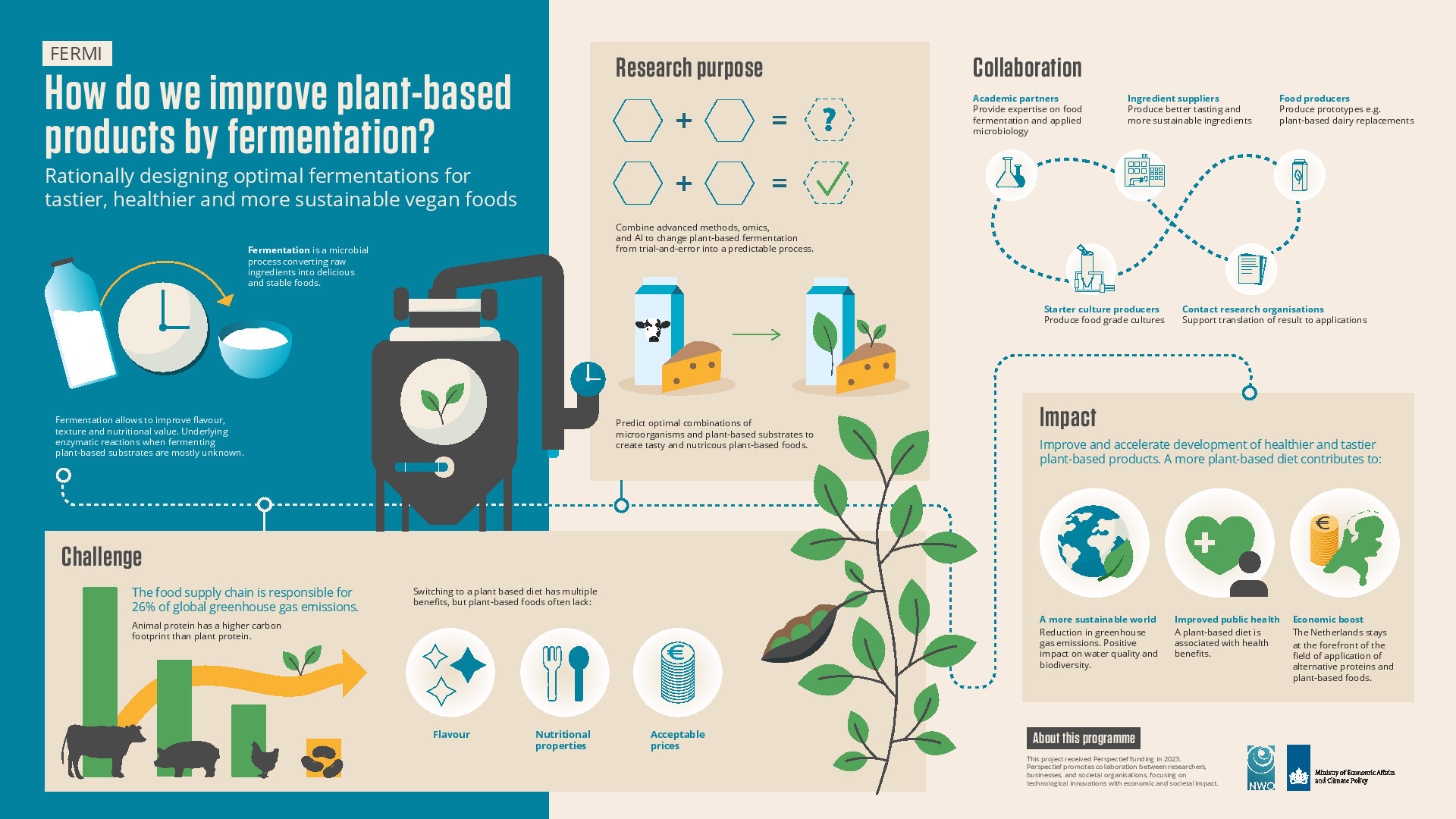
The Fermi Project: Tackling Plant-Based Fermentation Challenges
Herwig Bachmann spearheads the Fermi project, an ambitious collaboration bringing together twelve industrial and three academic organizations to tackle issues in the fermentation of plant-based substrates. The partners include influential players
 across the value chain such as NIZO Food research, DSM-Firmenich, Unilever, Flora Food Group, Bel-Group, Novonesis, Ferrero, Arla, IFF, and Roquette, the world’s largest pea protein producer: “With the Fermi project, we try to determine what is important during the fermentation of plant-based substrates, and the participating companies test our predictions in their products”. The Fermi Project budget is almost six million and lasts for six years.
The central aim in this project is to pinpoint the enzymes that contribute to the removal of off-flavors, a process they explore through both scientific investigation at the universities and practical product trials at the companies.
Beyond Fermi: Entrepreneurial Innovation and VU Research
Besides his leadership in the Fermi project, Bachmann pursues a range of activities at VU: “In one of his projects they work on the evolution of microbial consortia and understanding the microbial ecology behind it, which is then also applied in food fermentations”.
Second, he and his team are developing new methods for experimental evolution. Their aim with a newly developed technology is to commercialize a single-use experimental evolution device, which allows microbes to grow and evolve over months without daily intervention: “We have a method for which you don’t have to subculture every day and in addition selects for properties that we could not select for so far”. This project is also supported by a Biotech Booster grant.
Vision for the Future and Advice
Bachmann highlights the importance of broad collaboration, tangible goals, and adaptable infrastructure. He stresses that significant breakthroughs when it comes to industrial fermentations come not only through technical ingenuity, but also through readiness to address practical issues and societal demands; “There is limited value in results that can not be implemented in a production environment. That’s why it’s important to collaborate with all stakeholders. We sometimes need to bring things back to the practical aspects, and often the beauty and applicability lies in the simplicity of a solution”.